
The True Cost of Downtime (By Industry)
TL;DR
.avif)
Every engineering team knows that downtime is expensive. But “expensive” is vague — and vague is hard to act on. When someone asks why the team should invest in better monitoring or incident response tooling, “downtime is bad” doesn't move the needle.
Specific numbers do.
The real cost of downtime varies enormously by industry, business size, and the nature of the failure. Here's what the data says — and what it means for how seriously you should take your monitoring setup.
How Downtime Cost Is Calculated
The total cost of a downtime event typically includes:
- Direct revenue loss — sales that didn't happen, transactions that failed
- Productivity loss — internal teams unable to work, engineers pulled into incident response
- Recovery costs — overtime, emergency vendor support, infrastructure changes
- Reputational damage — customer churn, negative reviews, lost trust
- SLA penalties — contractual obligations to enterprise customers
The last two are the hardest to quantify, but often the most damaging in the long run.
E-Commerce
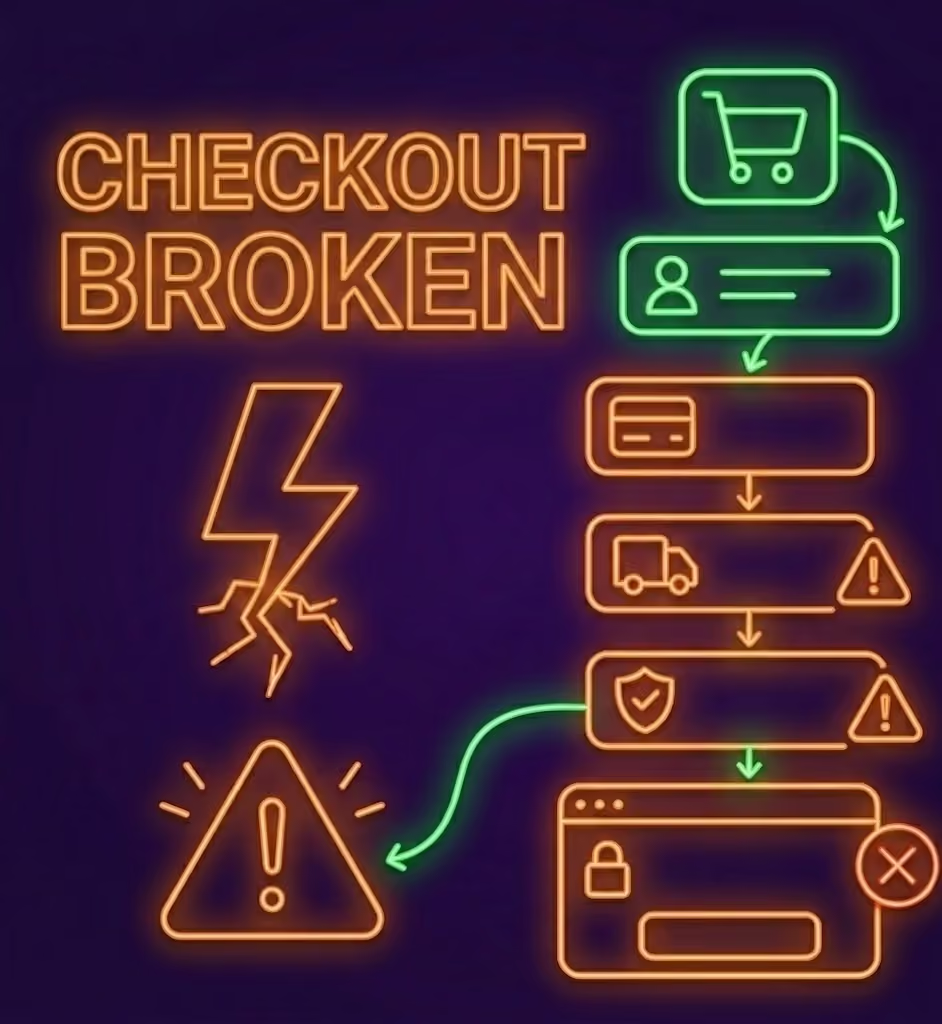
For ecommerce businesses, downtime has an almost immediate and direct revenue impact. When your checkout doesn't work, revenue stops.
Amazon reportedly loses around $220,000 per minute during outages — but that's the extreme end of the scale. For a mid-size ecommerce business doing $10M in annual revenue, an hour of downtime during peak hours could cost $3,000–$8,000 in direct lost sales alone, before factoring in abandoned carts that don't convert later.
The highest-risk windows: Black Friday, Cyber Monday, product launches, and flash sales. These are exactly when traffic spikes put maximum stress on infrastructure — and when the cost of failure is highest.
SaaS / B2B Software
For SaaS companies, downtime hits differently. The immediate revenue impact might be lower (users can't churn mid-outage), but the SLA and trust implications are severe.
Enterprise SaaS contracts often include SLA guarantees of 99.9% or 99.99% uptime. A single hour of unplanned downtime in a month puts you in breach of 99.9% SLA (which allows ~43 minutes of downtime per month). Penalties can include service credits, contract reviews, or churn.
Beyond contracts: in B2B software, your product is a business-critical tool. When it goes down, your customers' teams can't work. The frustration that generates translates directly into renewal conversations.
Industry estimates put the average cost of downtime for SaaS companies at $5,600–$9,000 per minute for larger platforms, with smaller SaaS businesses experiencing costs of $500–$2,000 per hour including productivity impact.
Financial Services
Financial services downtime is in a category of its own. Banks, payment processors, and trading platforms have some of the highest downtime costs of any industry — and the most significant regulatory implications.
Trading platform outages can prevent millions in transactions during market hours. Payment processor outages cascade to every business using them. Banking app outages generate regulatory scrutiny and can trigger mandatory reporting requirements.
The Ponemon Institute has estimated average downtime costs for financial services at over $100,000 per hour. High-frequency trading systems lose far more.
Healthcare
Healthcare downtime is less about direct revenue and more about patient safety and regulatory compliance. When EHR systems, appointment booking, or patient portals go down, the operational impact is immediate.
Staff revert to paper-based processes. Appointments are delayed or missed. Critical patient data may be temporarily inaccessible. The cost is measured in operational disruption, staff time, and in serious cases, patient harm.
Media and Publishing
For media companies, downtime during high-traffic events (breaking news, live sports, award shows) means both direct ad revenue loss and audience that goes to competitors and doesn't come back. CDN and infrastructure costs make prevention relatively cheap compared to the cost of a high-traffic outage.
What This Means for Your Monitoring Budget
If your business loses $2,000 per hour of downtime, and better monitoring reduces your average incident duration by 30 minutes and prevents 2 incidents per year, you've saved $2,000. If your monitoring costs $50/month, the ROI is not even close.
The question isn't whether you can afford monitoring. It's whether you can afford not to have it.
And the most important insight from the data: the businesses that detect outages fastest — through automated monitoring rather than customer reports — have significantly shorter incidents and lower total costs. Mean time to detect (MTTD) is the metric that matters most.
Final Thoughts
Downtime will happen. The question is how long it lasts, how quickly you know about it, and whether you had the context to fix it fast. Monitoring doesn't prevent every failure — but it dramatically reduces the window between “something broke” and “we fixed it”.
Every minute of that window costs money. Act accordingly.
Key Takeaways
- Direct checkout loss is only the surface cost because secondary operational factors like wasted ad spend and internal engineering scrambling run up the actual bill.
- Customer trust degradation triggers massive long-tail attrition spikes that frequently show up weeks after an infrastructure incident is fully resolved.
- Proactive infrastructure monitoring pays for itself instantly by catching performance degradation paths before a total server system collapse occurs.
Frequently Asked Questions
How do you accurately calculate the true cost of an hour of application downtime?





%20%E2%80%94%20And%20How%20Is%20It%20Different%20from%20Synthetic%3F.avif)